Reset & Apply
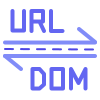
The library keeps two pieces of state separate:
- An internal
URLSearchParamsthat tracks what the form currently shows. It is updated on everychangeevent automatically. - The actual URL (
location.search). It is only written bysetFiltersToUrl()andresetUrl(), never by change events.
That split is what lets you batch many field edits into a single history entry. To commit the internal state to the URL you call setFiltersToUrl — typically from an Apply button.
Apply
const filter = new Filter({
  formAttr: 'data-filter-form="search"',
  filterAttr: 'data-filter',
});

filter.init();

document.querySelector('[data-filter-apply]')?.addEventListener('click', () => {
  filter.setFiltersToUrl(new URL(window.location.href));
});
setFiltersToUrl performs a single history.pushState from the current form state, so only one history entry is created no matter how many fields the user changed.
Reset
A native <button type="reset"> inside the form clears the inputs. Pair it with filter.resetUrl() to clear the URL params at the same time:
document.querySelector('[data-filter-reset]')?.addEventListener('click', () => {
  filter.resetUrl();
});
Or call both explicitly if you don't have a native reset button:
filter.resetDom();
filter.resetUrl();
Auto-apply on every change
If you want the URL to update on every change instead of only on Apply, listen for change yourself and call setFiltersToUrl:
$form.addEventListener('change', () => {
  filter.setFiltersToUrl(new URL(window.location.href));
});
Each change becomes its own history entry. Sensible for small forms; bad for forms with many fields where each keystroke or scrub would create a useless entry.
Helper methods
| Method | Effect |
|---|---|
resetDom() | form.reset() — clears the inputs but leaves the URL alone |
resetUrl() | Removes every known filter param from the URL via pushState |
updateDom() | Re-reads the URL and pushes it into the form (use after URL writes from outside the library) |
getFilters() | Returns the parsed { [type]: string[] } snapshot of the internal state |
destroy() | Removes all change and popstate listeners added by init() — call on component teardown |
Combining with data fetching
The library does not fetch data. Wire your loader to popstate plus your own commit point (Apply click, or every change if you went auto-apply), and call it with filter.getFilters():
const load = () => fetchResults(filter.getFilters());

window.addEventListener('popstate', load);
document.querySelector('[data-filter-apply]')!.addEventListener('click', load);

load();